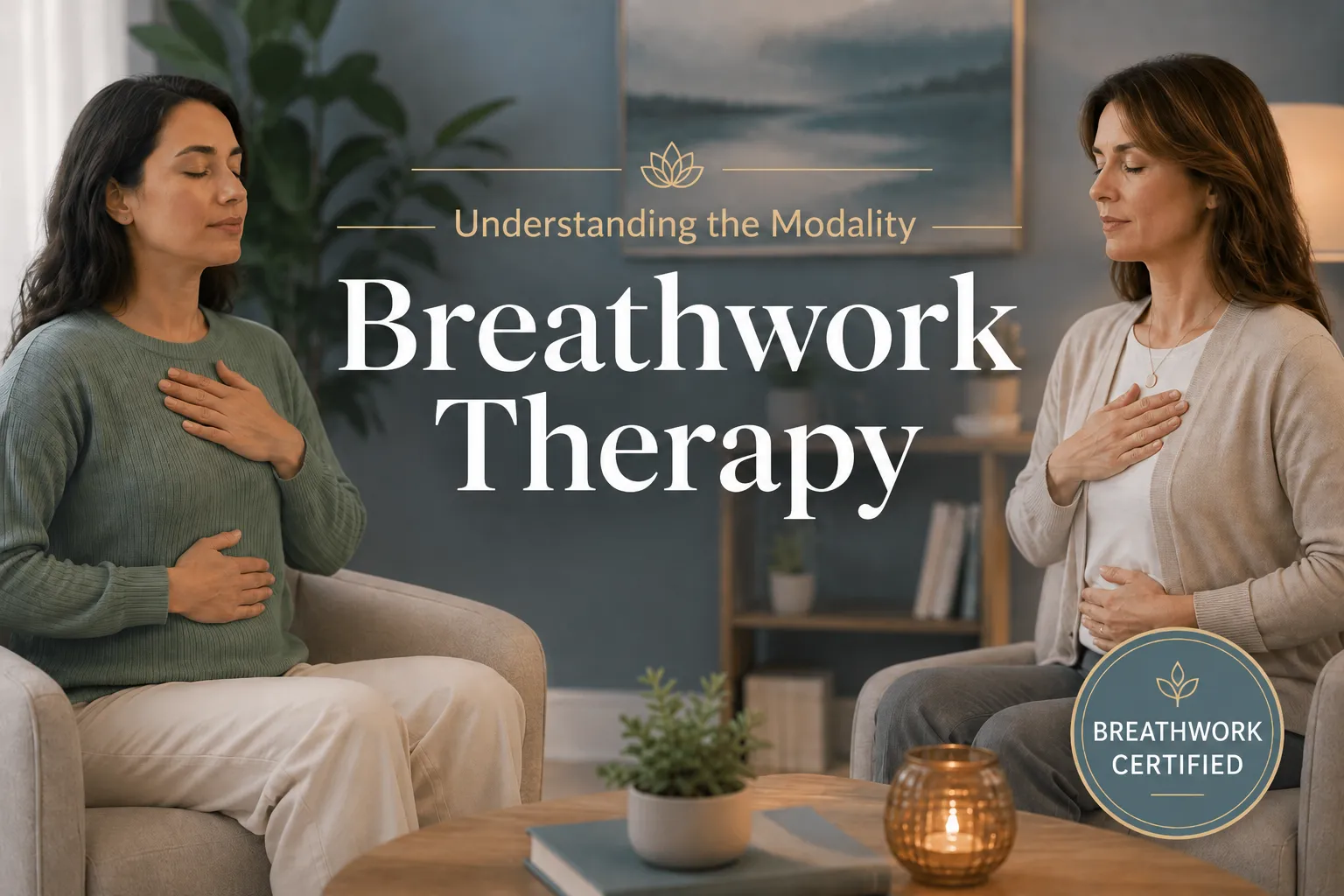
 Of all the tools I use in my practice, breathwork therapy is the one people tend to underestimate. It sounds almost too simple. Everyone breathes. How could something so ordinary do meaningful therapeutic work?
Here’s what I’ve come to understand, both through formal training and through years of sitting with clients: the breath is one of the most direct ways we have to influence how we feel. It’s the only vital function that runs automatically and yet responds instantly the moment we direct it. That makes it a bridge between the parts of ourselves we control and the parts that seem to run on their own, including the stress responses, the tension, and the old emotional holding patterns that talk alone doesn’t always reach.
This article explains what breathwork actually is in a therapy setting, how I use it in my practice, and what the Integral Breath Therapy training behind my approach involves.
What Breathwork Is (and What It Isn’t)
Breathwork means using intentional, controlled breathing to ease stress, build self-awareness, and support emotional processing. In a clinical setting, it looks quite different from what you might find in a fitness class or a wellness video. There’s nothing wrong with those, but what I offer is breathwork woven into psychotherapy, guided by clinical training, and used purposefully as part of a larger treatment plan.
The starting point is physiology. Your breath and your nervous system are in constant conversation. When you’re anxious or threatened, breathing becomes fast and shallow, part of the body’s alarm response. Slow, deep, intentional breathing sends the opposite signal. It engages the body’s natural relaxation response, easing the physical tension that keeps us on edge. This isn’t a fringe idea; it’s basic physiology, and it’s why breathing techniques show up in nearly every evidence-based approach to anxiety.
But there’s a deeper layer. Many of us learned early in life to hold difficult emotions at bay by tensing up and breathing shallowly. Over time that becomes a habit, and it can dampen our capacity for ease, connection, and vitality. Breathwork gently works against that pattern, helping the body release what it has been holding, sometimes for a very long time.
The Training Behind My Approach: Integral Breath Therapy
I hold a certificate in Integral Breath Therapy through Integration Concepts, a training organization that has been teaching this modality to healthcare professionals since 1997. I mention the credential not to decorate a bio but because it matters: breathwork done well is a skill, and breathwork done carelessly with someone carrying unresolved trauma can be overwhelming rather than helpful. The training is a significant part of why I trust this work.
Integral Breath Therapy is a body-centered approach built around conscious, connected breathing, sometimes called circular breathing, a continuous flow of breath without pauses between inhale and exhale. This breathing style can shift you into a relaxed, focused state where deeper emotional material becomes accessible in a way that ordinary conversation doesn’t always allow.
The certification process is substantial. It involves two intensive multi-day trainings, first a foundation course in the model and its techniques, then a certification intensive focused on facilitating individual sessions, followed by supervised practice and case study work. One principle from the training has stayed with me and shapes every session: the facilitator doesn’t lead the client through the experience. I accompany you. Your body and your breath set the pace, and my role is to keep the process safe, grounded, and connected to the goals we’re working toward in therapy.
What a Breathwork Session Is Like
In my practice, breathwork isn’t a standalone service. It’s a modality I integrate into therapy when it fits, the same way I use EMDR or clinical hypnotherapy when they fit. Sometimes that means a few minutes of guided breathing to settle the nervous system before difficult work. Sometimes it means a fuller breathwork process within a session.
In a fuller session, you’re seated or reclining comfortably. I guide you into the connected breathing rhythm, and we let the process unfold. People notice a range of experiences: physical sensations like tingling or warmth, waves of emotion rising and moving through, memories surfacing, or simply a settling into deep calm. Whatever comes up, you remain aware and in control throughout. Afterward, we talk about what you noticed, and we connect it to the larger work you’re doing.
Clients often describe leaving these sessions feeling more grounded, clearer, and lighter, as though something they’d been carrying had loosened its grip.
How Breathwork Fits Into Trauma and Anxiety Work
Breathwork earns its place in my practice for a few specific reasons.
First, it’s a stabilization tool. Trauma work requires a foundation: before processing painful material, you need reliable ways to calm your own nervous system. Breathing techniques are among the most practical and portable skills I can teach, and they’re a core part of the preparation phase in EMDR work. You carry your breath everywhere, which means you carry the tool everywhere.
Second, for anxiety, breathwork addresses the physical side of the struggle directly. Anxiety isn’t only anxious thoughts; it’s a racing heart, a tight chest, shallow breathing. Working with the breath interrupts that loop at the body level, which often makes the thought-level work of therapy more effective.
Third, trauma and long-held stress live in the body, not just the mind. Talk therapy reaches understanding, and understanding matters, but some of what we carry doesn’t respond to insight alone. Breathwork offers a way of working with what the body has been holding, which is why I find it pairs so naturally with EMDR and hypnotherapy in trauma-focused treatment.
Is Breathwork Therapy Right for You?
Breathwork can be a meaningful part of healing for anyone working through stress, anxiety, unresolved tension, or the lasting effects of difficult experiences, or for anyone who simply wants to feel steadier and more connected. It tends to resonate with people who sense that their struggles aren’t only in their thoughts, that their body is part of the story too.
A few honest notes. Breathwork is a complement to therapy, not a replacement for it, and the deeper emotional work it can open up deserves a trained, supportive presence. Certain breathing practices may also not be appropriate for people with some respiratory or cardiovascular conditions, so if you have a relevant health concern, it’s worth mentioning when we talk. And as with everything in my practice, nothing is forced. If breathwork fits your goals and your comfort level, we use it. If it doesn’t, we have other tools.
If you’re curious about breathwork as part of counseling, I’d be glad to talk with you about whether it fits what you’re working on. You can reach me at 561-717-2900 or contact Morgan Center for Counseling and Wellbeing to schedule a consultation. I see clients in person in Boca Raton and via telehealth throughout Florida.
Meet the Therapist

 Jody Morgan, LCSW, CCTP is the founder of the Morgan Center for Counseling and Wellbeing in Boca Raton. He is a compassionate psychotherapist dedicated to helping individuals grow and heal, using evidence-based and body-centered approaches including EMDR, clinical hypnotherapy, CBT, and breathwork to help clients work through trauma, anxiety, depression, and grief. He offers telehealth therapy in the State of Florida.
- Licensed Clinical Social Worker (LCSW)
- Certified Clinical Trauma Professional
- EMDR Certified
- Advanced Clinical Heart-Centered Hypnotherapist
- Member, Florida Society of Clinical Hypnosis
- Certificate in Integral Breath Therapy (Integration Concepts)
At Morgan Center, Jody Morgan provides private psychotherapy services that lead to lasting relief. His experience and evidence-based techniques help clients overcome the effects of grief, trauma, and anxiety, and achieve meaningful change. He has helped clients break free from the effects of trauma. Treatment services are tailored to meet the specific needs of each client.