 There is a moment I witness in my office, sometimes weeks into treatment, sometimes sooner, when something shifts. A client who has carried a particular memory like a stone in their chest for years will look up at me and say, almost with surprise, “It doesn’t feel like that anymore.” The memory is still there. But the weight of it has changed.
That moment is why I trained in EMDR. And it is the reason I continue to offer EMDR therapy as one of the primary treatment approaches in my practice.
If you are reading this because you are considering therapy, or because you have heard about EMDR and want to understand whether it might be right for you, here is a walk-through of what it actually is, what happens during a session, and what the research and my clinical experience tell me about what clients can genuinely expect.
What Is EMDR Therapy?
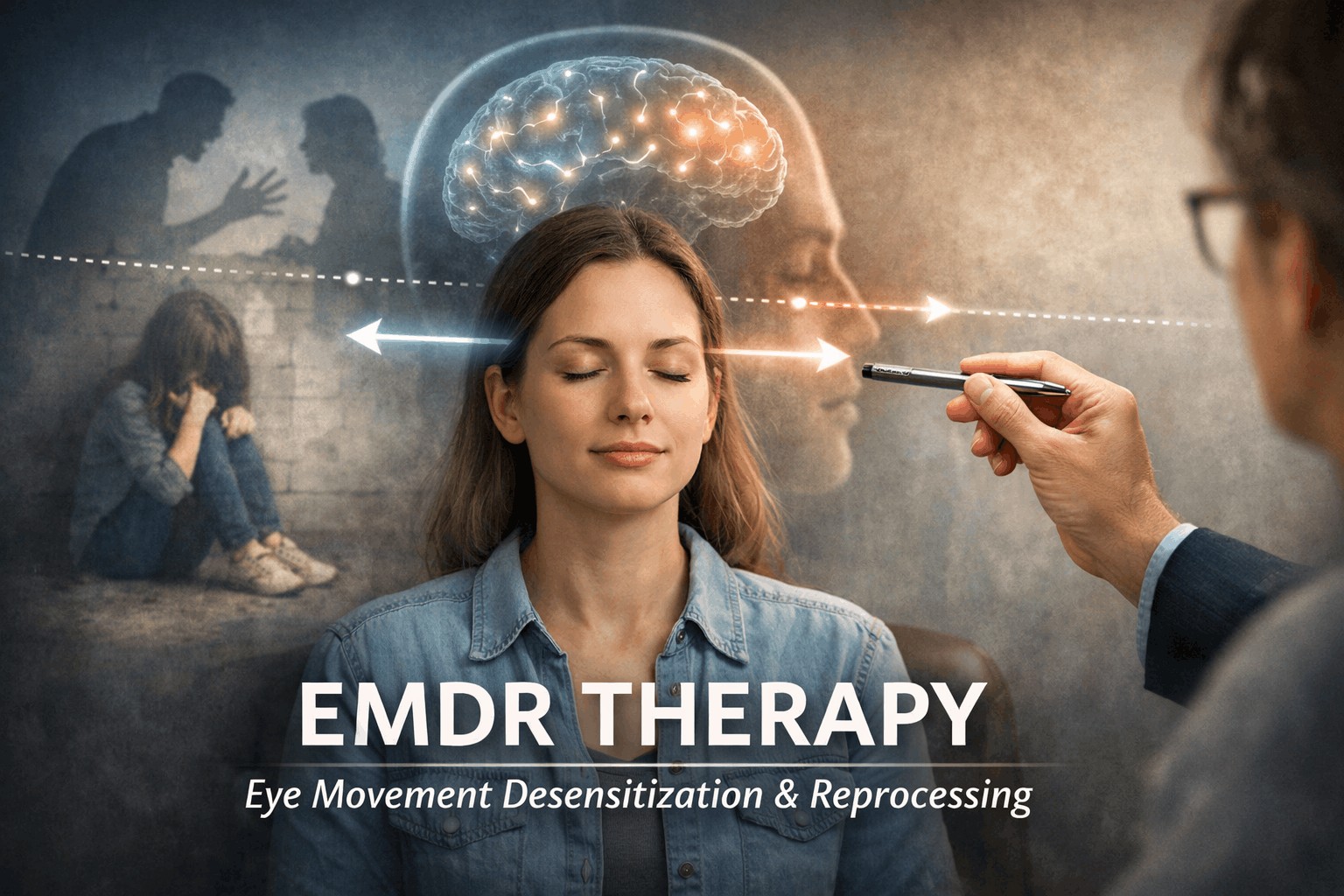
EMDR stands for Eye Movement Desensitization and Reprocessing. It is a mouthful, but the concept behind the name is more intuitive than it sounds.
Developed in the late 1980s by psychologist Dr. Francine Shapiro, EMDR was originally designed to treat post-traumatic stress disorder (PTSD). What Shapiro noticed, and what decades of research have since validated, is that the brain sometimes fails to fully “process” traumatic or distressing experiences the way it processes ordinary events. Instead of being filed away as a past memory, these experiences get stored in a raw, unintegrated form. They stay emotionally charged. They intrude. They drive anxiety, avoidance, shame, and a host of other symptoms that don’t seem to respond to insight or understanding alone.
EMDR works by targeting those unprocessed memories directly, using bilateral stimulation, typically guided eye movements, taps, or tones that alternate from side to side, to activate the brain’s natural information processing system. The work helps the brain finally do what it could not do on its own in the aftermath of a traumatic event.
The World Health Organization, the American Psychiatric Association, and the U.S. Department of Veterans Affairs all recognize EMDR as an evidence-based treatment for trauma. In my Boca Raton trauma therapy practice, I have used it with clients recovering from single-incident traumas (car accidents, medical crises, assaults) as well as those with complex, developmental trauma accumulated across a lifetime.
How EMDR Treatment Actually Works: Inside the Eight Phases
One of the things I hear most often from prospective clients is some version of: “I’ve heard EMDR is intense. Is it safe?” I understand the concern. Any therapy that touches trauma deserves to be approached thoughtfully, with respect and compassion.
What I tell my clients is this: EMDR is structured. It follows a clear, eight-phase protocol that was designed specifically to keep you within a manageable window of processing, never flooded and never shutting down. Here is what that looks like in practice.
Phase 1: History and Treatment Planning
Before we ever do a single set of eye movements, I spend time getting to know you. We talk about your history, what brings you to therapy, what symptoms are most disruptive to your life, and what experiences may be driving them. This is not a quick intake. It is foundational, and the way I practice EMDR does not rush this phase.
Phase 2: Preparation
This phase is about making sure you have the internal resources to do the work ahead. I teach stabilization skills, including grounding techniques, containment strategies, and ways to regulate your nervous system if you become overwhelmed. Clients often tell me this phase alone has been valuable, giving them tools they did not have before.
Phases 3 through 6: Assessment, Desensitization, Installation, and Body Scan
This is the core of the EMDR protocol. Together, we identify a specific target memory, including the image, the negative belief it carries (“I am not safe,” “I am worthless,” “I had no control”), and where you feel it in your body. Then, while you hold the memory in mind, I guide you through sets of bilateral stimulation, usually following my moving fingers with your eyes, though I also use tapping or auditory tones depending on what works best for you.
Between each set, I ask you simply what comes up. There is no right answer. What tends to happen is that the memory begins to shift. Its emotional charge reduces, new associations emerge, and the story the brain has been telling about it begins to update. We then work to install a more adaptive belief in its place (“I did the best I could,” “I am safe now”), and close with a body scan to ensure no residual tension remains.
Phases 7 and 8: Closure and Reevaluation
Every session ends with closure, returning you to a state of equilibrium before you leave. And at the start of each subsequent session, we reevaluate the previous target to see how it has settled. Processing often continues between sessions as the brain keeps integrating, and many clients report noticing changes in their daily life, including reduced reactivity, better sleep, and a sense of greater spaciousness, in the days following a session.
What Conditions Does EMDR Treat?
While EMDR was developed for PTSD, its applications have expanded considerably. In my therapy practice, I use EMDR to treat a wide range of concerns, including:
- Post-Traumatic Stress Disorder (PTSD) and complex PTSD
- Anxiety disorders, including generalized anxiety, social anxiety, and panic
- Depression rooted in adverse life experiences
- Grief and loss, particularly traumatic or complicated bereavement
- Phobias and performance anxiety
- Childhood trauma and attachment wounds
- Survivors of abuse, whether physical, emotional, or sexual
- First responders and others with occupational trauma
- Medical trauma and health-related anxiety
What unites all of these is the role of unprocessed experience in driving present-day suffering. EMDR gets at that root in a way that purely verbal therapies sometimes cannot.
The Benefits Clients Typically Experience with EMDR
Based on both the clinical research and what I see in my Boca Raton EMDR practice, the benefits clients experience include:
- Lasting reduction in trauma symptoms. Unlike approaches that manage symptoms without addressing their source, EMDR aims to reprocess the underlying material. Many clients find that once a memory is fully processed, its power over them is genuinely diminished, not suppressed but metabolized.
- Faster relief than talk therapy alone. Research consistently shows EMDR can produce significant symptom reduction in fewer sessions than traditional cognitive-behavioral therapy for trauma. That does not mean it is a quick fix, but for many clients, the efficiency is meaningful.
- Processing without re-traumatization. One of the most important features of EMDR is that you do not need to describe your trauma in detail, or narrate it at length, for processing to occur. The bilateral stimulation does much of the work. Clients often describe EMDR as more tolerable than they expected.
- Changes that generalize. When we successfully process a core memory or belief, the change often ripples out. Clients notice they are less reactive to current triggers, more present in relationships, and more able to tolerate uncertainty and discomfort.
- Embodied healing. EMDR attends to the body, not just the mind. The body scan phase ensures that healing is felt, not merely intellectualized. Many trauma survivors have experienced their body as the site of suffering. EMDR can help reclaim it as a site of safety.
EMDR Trained vs. EMDR Certified: Why the Distinction Matters
If you are searching for an EMDR therapist, you may come across clinicians who describe themselves as either “EMDR trained” or “EMDR certified,” and it is worth understanding what those terms actually mean before you make a decision. Learn more about EMDR Trained vs. Certified.
Why I Offer EMDR Treatment in Boca Raton
South Florida has a remarkable community, and in my years of practice in Boca Raton I have worked with people from all walks of life: professionals managing high-functioning anxiety, retirees navigating loss, parents carrying wounds from their own childhoods that have begun showing up in their parenting, survivors rebuilding after relationships they barely escaped. Trauma does not have a demographic. It does not care whether your life looks good from the outside.
What I find in my practice is that people are often looking for something beyond symptom management. They want to understand why they feel the way they feel, and they want to actually change it, not just cope with it indefinitely. EMDR, more than any other modality I have trained in, offers that possibility.
I am an EMDRIA Certified EMDR therapist, and I engage in ongoing consultation and continuing education in trauma treatment. The evidence base for EMDR continues to grow, and I believe in staying current with what the research tells us about how to do this work responsibly and effectively.
Is EMDR Right for You?
That is a question I can only begin to answer in a consultation, and I would encourage anyone who is curious to reach out and have that conversation. But here are some indicators that EMDR therapy might be worth exploring:
- You have tried talk therapy and find that insight alone hasn’t shifted the way you feel
- You struggle with intrusive memories, flashbacks, or emotional reactions that seem disproportionate to the current situation
- You carry a persistent negative belief about yourself that doesn’t respond to logic or reassurance
- You have a history of adverse childhood experiences, including emotional neglect, which is often overlooked
- You have experienced a specific traumatic event and continue to be haunted by it
- You feel emotionally “stuck” in a way you can’t quite explain
EMDR is not appropriate for everyone, and there are situations, including active psychosis, certain dissociative disorders, and severe current life instability, where other work needs to happen first. A thorough assessment is always the starting point. I will never push a client into trauma processing before they are ready. That preparation work is not a detour; it is the foundation everything else is built on.
A Final Word
Trauma is not a life sentence. That is something I believe deeply, and it is something I have watched EMDR demonstrate, over and over, in the lives of people who came to me having lost hope that they could feel differently.
The brain is more capable of healing than most of us were taught to believe. EMDR therapy does not erase the past. It changes your relationship to it. And for many people, that difference is everything.
If you are considering EMDR treatment in Boca Raton and want to learn more, I invite you to reach out for a consultation. We can talk about what you are carrying, what you are hoping for, and whether EMDR might be the right path forward for you. There is no obligation, and no judgment. Just a conversation, and the possibility that something might shift.
Meet the Therapist

 Jody Morgan, LCSW, CCTP is the founder of the Morgan Center for Counseling and Wellbeing in Boca Raton. He is a compassionate psychotherapist dedicated to helping individuals grow and heal. With extensive training and certifications, Jody specializes in trauma-focused treatments, including EMDR therapy.
- Licensed Clinical Social Worker (LCSW)
- Certified Clinical Trauma Professional
- EMDR Certified
- Advanced Clinical Heart-Centered Hypnotherapist
- Certificate in Integral Breath Therapy (Integration Concepts)
At Morgan Center, Jody Morgan provides private psychotherapy services that lead to lasting relief, including EMDR therapy. His experience and evidence-based techniques help clients overcome the effects of grief, trauma, and anxiety, and achieve meaningful change. He has helped clients break free from the effects of trauma. Treatment services are tailored to meet the specific needs of individuals affected by these issues, offering emotional support and guidance throughout the process.