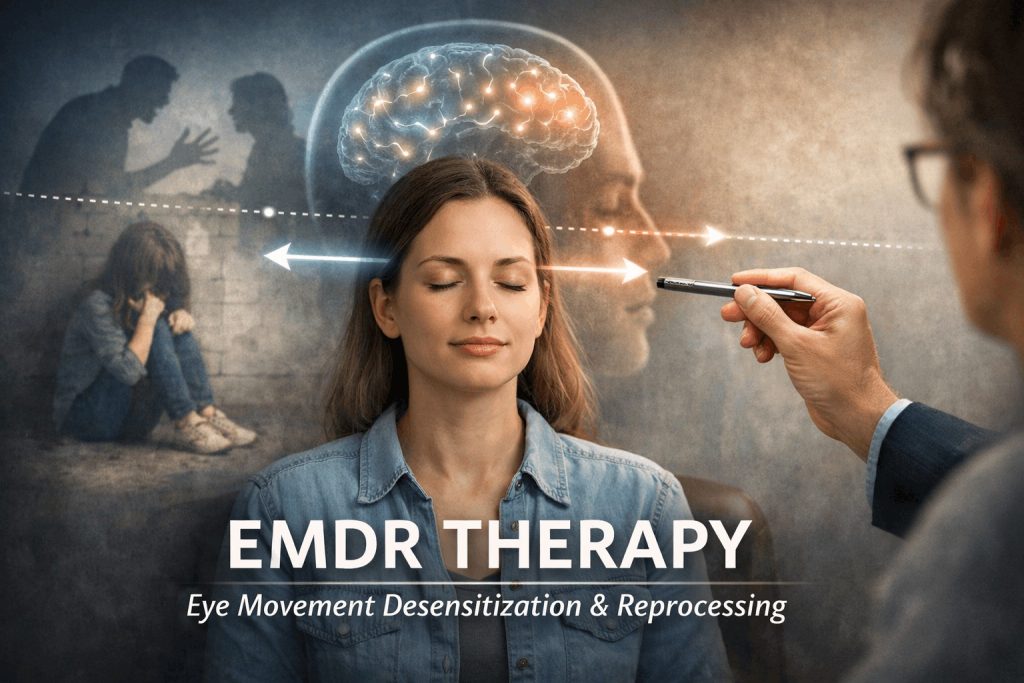
 Does EMDR really work? I want to answer this question as honestly as I can, because setting realistic expectations matters for anyone considering EMDR treatment.
After years of practice, EMDR certification through EMDRIA, and hundreds of clients sitting across from me in sessions, I have a fairly clear sense of when EMDR works, why it works, and just as importantly, when it doesn’t. The internet is full of glowing testimonials and, on the other end, skeptical dismissals. Neither extreme gives you the full picture. What follows is a grounded, clinically informed answer from someone who has watched this therapy change people’s lives and also watched it fall short.
The honest answer: yes, often profoundly, and not for everyone, not always, and not without the right conditions in place.
What the Research Actually Says About EMDR Effectiveness
Let’s start with the science, because it’s more solid than many people realize.
EMDR is one of the most extensively researched psychotherapies for trauma. The World Health Organization recommends it as a first-line treatment for PTSD. So does the American Psychiatric Association, the U.S. Department of Veterans Affairs, and the International Society for Traumatic Stress Studies. That is not a fringe endorsement. That is as close to consensus as mental health treatment gets.
Multiple randomized controlled trials have found that EMDR produces significant reductions in PTSD symptoms, often in fewer sessions than traditional cognitive behavioral therapy. Studies have found response rates ranging from 77 to 90 percent for single-trauma PTSD, meaning the large majority of participants no longer met diagnostic criteria after treatment. Those are remarkable numbers for any psychological intervention.
But research averages don’t sit across from you in a therapy chair. They don’t tell you whether EMDR will work for you, specifically, with your particular history and nervous system and life circumstances. That is where clinical experience fills in what the studies can’t.
Why Does EMDR Work? The Mechanism Behind the Method
This is the question I find most fascinating, and one that researchers are still actively exploring. The short answer is that we don’t have a complete, universally agreed-upon explanation, but we have compelling theories, and the clinical evidence for effectiveness doesn’t depend on resolving the mechanism debate.
The most widely accepted explanation centers on what’s known as the Adaptive Information Processing model. The idea is that the brain has a natural system for processing experiences and integrating them into memory. After a traumatic event, that system can get stuck. The memory is stored in a raw, unprocessed form, locked in the nervous system with all of its original emotional charge intact. That’s why a trauma survivor might hear a car backfire and experience the full physiological response of the original threat. The brain hasn’t filed the memory as past. It is still treating it as current.
EMDR’s bilateral stimulation, including the guided eye movements, tapping, or tones, appears to activate the brain’s natural processing system while the traumatic memory is held in mind, allowing it to finally be metabolized and stored as an ordinary past event. Some researchers draw a parallel to what happens during REM sleep, where the eyes move rapidly and the brain consolidates and integrates the day’s experiences. Whether that analogy is precisely accurate is debated, but the functional result, that distressing memories lose their charge, is consistently observed.
I explain it to clients this way: imagine the memory is a splinter your body never fully pushed out. It’s been sitting under the skin, causing inflammation and pain whenever it’s touched. EMDR is the process of finally getting that splinter out. The wound can then heal the way wounds are supposed to. You’ll still have a memory of the splinter. But touching the spot where it was won’t send a jolt of pain through your whole body.
When EMDR Doesn’t Work, and Why
Here is where I want to be especially direct, because I think it is what separates honest clinical writing from marketing.
EMDR does not work for everyone. And when it doesn’t, the reasons usually fall into a few recognizable patterns.
Insufficient stabilization
Trauma processing requires a stable enough foundation to work from. Clients who are in the middle of acute life crises, including an abusive relationship they haven’t left, active addiction, housing instability, or ongoing threat, often cannot do effective EMDR processing because the nervous system is still in survival mode. There is no regulated baseline to return to between sets. In these situations, the preparation phase needs to be extended substantially, and sometimes other stabilizing work needs to happen first. A therapist who rushes into trauma processing before this foundation is solid is not doing their client a service.
Severe dissociation
Clients with significant dissociative disorders, particularly dissociative identity disorder or severe structural dissociation, require a highly modified, specialized EMDR approach that goes well beyond standard protocol. Standard EMDR with these clients can destabilize rather than heal. I have referred clients to colleagues with specific expertise in dissociation when I have assessed that the standard approach would not serve them. That referral is not a failure. It is what responsible clinical practice looks like.
A poor therapeutic relationship
I say this without hesitation: EMDR does not work in the absence of a trusting therapeutic relationship. The bilateral stimulation is not magic on its own. The container, meaning the felt sense that you are safe with this person, that they see you, that they will not abandon you in the middle of something difficult, is not incidental to the treatment. It is part of the treatment. I have had clients come to me after EMDR experiences with other therapists that felt retraumatizing, and in nearly every case, when we explored it, the relational foundation simply was not there. The protocol was applied, but the person was not held.
Readiness and timing
Sometimes EMDR doesn’t work simply because the person isn’t ready. That is not a character flaw, just a reality of where they are in their process. I have had clients begin EMDR work, find it too activating, and step back into a period of purely supportive therapy before returning to it later with much better results. Readiness is not fixed. It can grow. The door doesn’t close.
Does EMDR Really Work for Anxiety? Depression? Grief? What About Complex Trauma?
These are among the most common search questions I see people asking, and they deserve a direct response.
- Does EMDR work for anxiety? Often, yes, particularly when the anxiety has roots in specific experiences. Generalized anxiety with no identifiable traumatic origin tends to respond more slowly, but anxiety driven by past experiences of threat, unpredictability, or helplessness frequently responds well to EMDR.
- Does EMDR work for depression? Research on EMDR and depression is growing, and the results are promising, particularly for depression that is rooted in adverse life experiences. Depression that is primarily biological in origin may need a different primary approach, though EMDR can still be a useful component.
- Does EMDR work for grief? This is nuanced. EMDR is not a grief therapy in the traditional sense. But when grief is complicated, when loss becomes traumatic, when a person is stuck in a particular moment of the loss and cannot move through it, EMDR can help dislodge that stuckness in a way that allows natural grieving to resume.
- Does EMDR work for complex PTSD? Yes, though the work typically takes longer and requires careful pacing. Complex PTSD, the kind that develops from prolonged, repeated trauma often in childhood, involves more diffuse networks of memory and belief that need to be addressed systematically. It is absolutely treatable with EMDR, but it is not a brief intervention. Be wary if you are told otherwise. That could be someone working with a different population or who is overpromising.
- Does EMDR work for childhood trauma? In my clinical experience, some of the most significant and durable changes I have seen have been in adults processing childhood trauma through EMDR. The memories may be old, but the nervous system has been carrying them as though they were recent. When those early experiences are finally processed, the effects can ripple through every domain of a person’s life, including their relationships, their self-concept, and their capacity to feel safe in the world.
How Do You Know If EMDR Is Working?
Clients ask me this regularly, especially in the early stages of treatment when progress can feel invisible from the inside. Here are the signs I watch for, and that I encourage clients to notice:
- The distress level when you bring a target memory to mind decreases over successive sessions, even if it doesn’t disappear entirely within a single session.
- You begin to notice that triggers that previously sent you into a full stress response feel less overwhelming in daily life. Not absent, but smaller.
- Spontaneous insights and shifts in perspective arise during processing. You find yourself understanding something differently without having been told to think about it that way.
- Sleep improves, often noticeably, sometimes before the client consciously registers other changes.
- There is a quality that clients describe in different ways, including “lighter,” “more spacious,” or “like something has moved,” that suggests the material is shifting.
- The negative belief associated with the target memory loses its grip. “I am worthless” begins to feel less true, not because you have been talked out of it, but because something has reorganized.
Progress in EMDR is not always linear. Some sessions feel productive; others feel like nothing moved. What I tell clients is that even sessions that feel uneventful are often doing work beneath the surface. The brain continues processing between sessions. Journals can help, and many clients find that noticing dreams, mood shifts, and spontaneous memories in the days following a session gives them a window into processing that’s happening outside the office.
My Honest Assessment After Hundreds of Sessions
So, does EMDR really work? I became an EMDR-certified therapist because I watched it do things I didn’t believe were possible with any other approach I had trained in. I have seen people release burdens they had carried for thirty or forty years. I have seen phobias dissolve that had shaped entire lifetimes of avoidance. I have sat with clients who came to me convinced that they were broken and watched them leave convinced, not intellectually but in their bodies, that they were not.
I have also seen EMDR not work. I have referred clients who weren’t ready. I have modified the protocol for clients whose trauma was too complex for standard treatment. I have had clients who found the approach too activating and needed a different path. That is not a failure of the therapy or of the client. It is the reality of treating the full spectrum of human suffering, which is never simple and never one-size-fits-all.
What I can tell you with confidence is this: if you are carrying the weight of experiences that will not stay in the past, if you find yourself reacting to the present with the full force of something that happened long ago, EMDR is worth a serious conversation. Not because it is guaranteed, but because the evidence for it is real, the clinical experience behind it is extensive, and the potential it holds for genuine, durable healing is unlike anything else I have encountered in this work.
If you are considering EMDR therapy and are based in or near Boca Raton, I would welcome the chance to talk. A consultation costs nothing but a little time, and it may be the beginning of something that changes a great deal. EMDR is a very potent modality that helps many clients, though not all, and an honest conversation up front is the best place to start.
Meet the Therapist

 Jody Morgan, LCSW, CCTP is the founder of the Morgan Center for Counseling and Wellbeing in Boca Raton. He is a compassionate psychotherapist dedicated to helping individuals grow and heal. With extensive training and certifications, Jody specializes in trauma-focused treatments, including EMDR therapy.
- Licensed Clinical Social Worker (LCSW)
- Certified Clinical Trauma Professional
- EMDR Certified
- Advanced Clinical Heart-Centered Hypnotherapist
- Member, Florida Society of Clinical Hypnosis
- Certificate in Integral Breath Therapy (Integration Concepts)
At Morgan Center, Jody Morgan provides private psychotherapy services that lead to lasting relief, including EMDR therapy. His experience and evidence-based techniques help clients overcome the effects of grief, trauma, and anxiety, and achieve meaningful change. He has helped clients break free from the effects of trauma. Treatment services are tailored to meet the specific needs of individuals affected by these issues, offering emotional support and guidance throughout the process.