

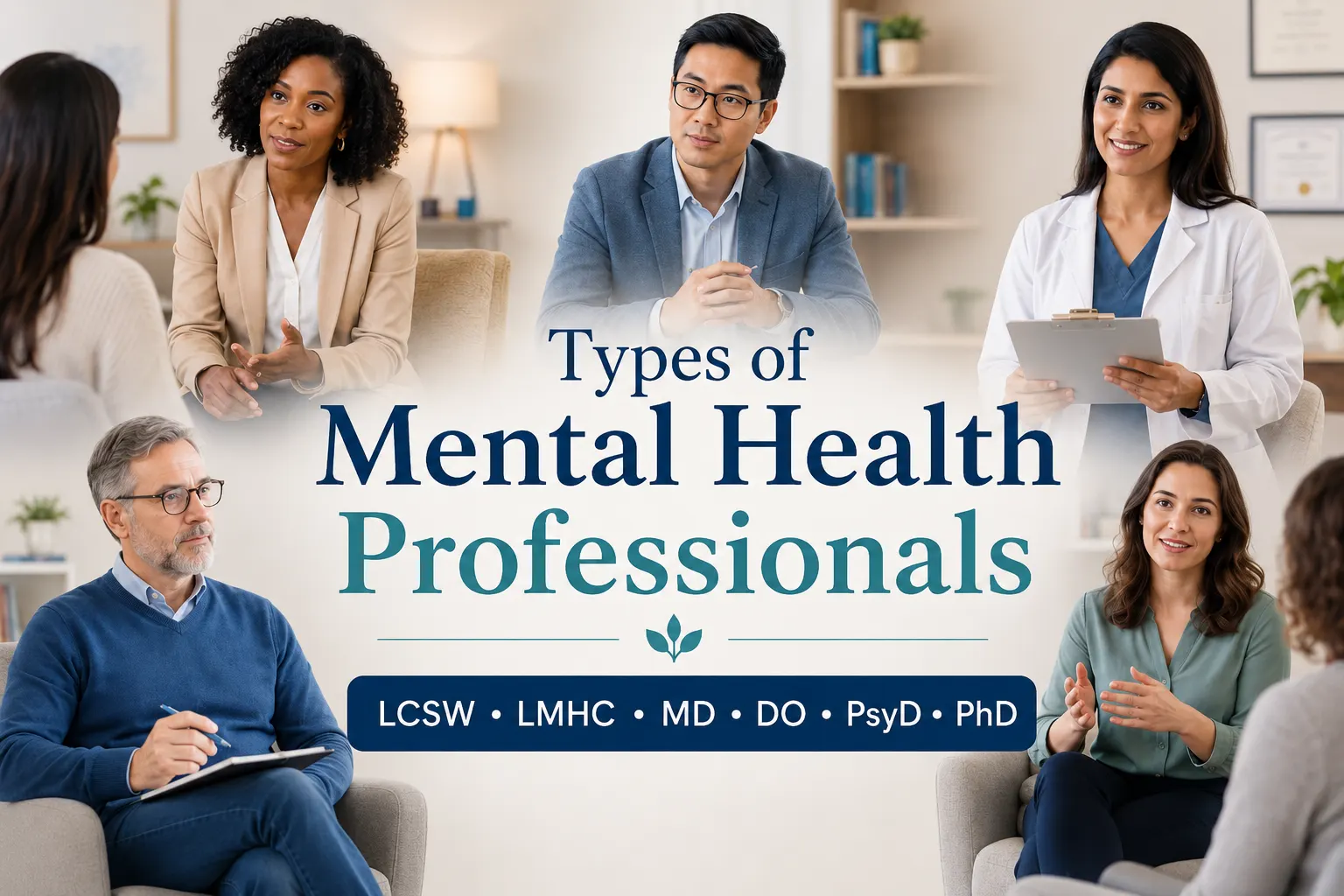
 When people start looking for a therapist, one of the first things they run into is a wall of letters: LCSW, LMHC, PhD, PsyD, MD. It’s not always clear what any of them mean, or whether the differences actually matter for the help you’re looking for. They do matter, though not always in the way people expect.
A note before diving in: mental health licensure is regulated state by state, so exact titles, requirements, and scope of practice can differ depending on where you live. What follows reflects how these credentials work in Florida, where I practice. If you’re searching for a therapist elsewhere, the broad categories below still apply, but it’s worth confirming the specifics with your own state’s licensing board.
Here’s a plain look at who’s who, and how to think about which might fit what you’re going through.
Licensed Clinical Social Worker (LCSW)
Social work training shapes how an LCSW sees a person’s struggles. It’s a master’s-level license (a master’s degree in social work, followed by at least two years of supervised clinical experience and a state licensing exam), and that background is rooted in a framework called Person-in-Environment (PIE): the idea that behavior can’t be understood in isolation, but is shaped by psychological, social, cultural, and spiritual factors together. LCSWs are trained to diagnose and treat mental health conditions, but they cannot prescribe medication. I go into more depth on this license, including a hypothetical case comparison, in LCSW vs. LMHC and LCSW vs. Psychologist.
Licensed Mental Health Counselor (LMHC)
In Florida, an LMHC holds a master’s degree in counseling or a closely related field, along with supervised clinical experience and a licensing exam, similar in structure to the LCSW pathway. (Other states often use a different title for this same general license, commonly LPC or LCPC.) LMHCs are trained to diagnose and treat mental health conditions using evidence-based approaches like cognitive-behavioral therapy, with a clinical focus that’s often more concentrated on psychological technique from the start of their training. Like LCSWs, LMHCs cannot prescribe medication.
Psychologist (PhD or PsyD)
A psychologist holds a doctoral degree, either a PhD (research-focused) or a PsyD (clinically-focused), which typically takes several years longer to complete than a master’s-level license. Psychologists receive extensive training in psychological testing and assessment, which makes them the right choice when a formal evaluation is needed, for a learning disability, ADHD, or a diagnostic question that needs more structured assessment than a therapy conversation alone can answer. Psychologists also provide ongoing therapy. In most states, psychologists cannot prescribe medication, though a small number of states allow it with additional specialized training.
Psychiatrist (MD or DO)
Medication is the defining piece here. A psychiatrist is a medical doctor who completed medical school and a residency in psychiatry, and it’s the one license on this list that can prescribe. Psychiatric care often centers on medication management, diagnosis, and monitoring the biological side of a mental health condition. Some psychiatrists also provide therapy, though many focus primarily on medication and work alongside a separate therapist for the counseling piece. If medication is part of what you’re looking for, a psychiatrist, or a coordinated relationship between your therapist and a psychiatrist or your primary care physician, is the right direction.
Specialty Certifications: What CCTP and EMDR Certification Actually Mean
Beyond the base licenses above, you’ll often see additional letters or badges, like CCTP (Certified Clinical Trauma Professional) or EMDR Certified. These aren’t separate types of therapist; they’re specialized training a licensed clinician pursues on top of their degree, usually involving additional coursework, supervised practice, and in EMDR’s case, a rigorous certification process through the EMDR International Association. A specialty certification tells you that a clinician has gone beyond their general license to train specifically in a particular modality or population, which can matter a great deal if that’s exactly what you need help with.
Which One Is Right for You?
Here’s the honest answer: for most everyday concerns, anxiety, depression, relationship stress, grief, unresolved trauma, an LCSW or an LMHC is exactly the right starting point, and the specific license matters less than the individual clinician’s training, approach, and whether you feel understood by them. A psychologist becomes the better first call when you need formal testing or assessment. A psychiatrist becomes necessary when medication is part of the picture, either as a first step or alongside therapy.
None of these are mutually exclusive. Plenty of people work with a therapist for the ongoing counseling work and a psychiatrist for medication, coordinating between the two. The credential is a starting point for understanding someone’s training, not a verdict on how well they’ll be able to help you.
I’m an LCSW, a Certified Clinical Trauma Professional, and an EMDR Certified therapist practicing in Boca Raton. I use an integrative approach that draws on EMDR, clinical hypnotherapy, cognitive behavioral therapy, and breathwork, and when medication is part of someone’s care, I coordinate with their physician or a psychiatrist so the whole picture works together.
What I love most about my profession as a Licensed Clinical Social Worker is the well-rounded empathetic approach that we take with all clients. I always want to meet people where they are at any given time. I see the person and not the diagnoses, though a diagnosis can be helpful in clarifying objectives and goals in therapy. As we work within the Person-in-Environment framework, we consider what may contribute to the presenting issues as well as identifying the strengths, tools and support already available to the client.
If you’re trying to figure out what kind of support fits your situation, I’m glad to talk it through. Call (561) 717-2900 or schedule a session online.
Meet the Therapist

 Jody Morgan, LCSW, CCTP is the founder of the Morgan Center for Counseling and Wellbeing in Boca Raton. He is a compassionate psychotherapist dedicated to helping individuals grow and heal, using evidence-based approaches including EMDR, clinical hypnotherapy, CBT, and breathwork to help clients work through trauma, anxiety, depression, and grief. He offers telehealth therapy in the State of Florida.
- Licensed Clinical Social Worker (LCSW)
- Certified Clinical Trauma Professional
- EMDR Certified
- Advanced Clinical Heart-Centered Hypnotherapist
- Member, Florida Society of Clinical Hypnosis
- Certificate in Integral Breath Therapy (Integration Concepts)
At Morgan Center, Jody Morgan provides private psychotherapy services that lead to lasting relief. His experience and evidence-based techniques help clients overcome the effects of grief, trauma, and anxiety, and achieve meaningful change. He has helped clients break free from the effects of trauma. Treatment services are tailored to meet the specific needs of each client.

