

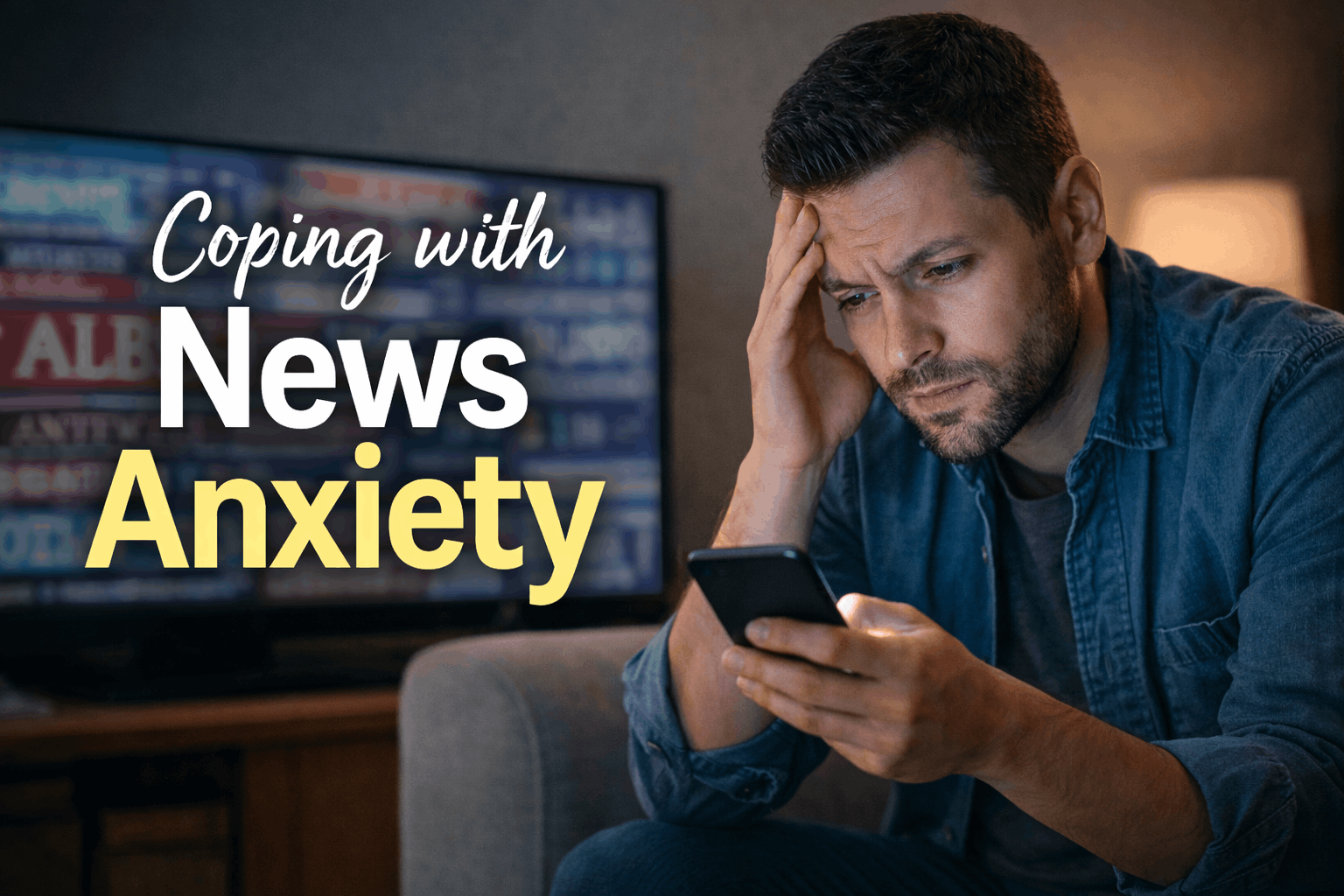
Living in a Constant State of Alert
 It’s hard to remember a time when the news didn’t feel overwhelming.
As a therapist, I regularly hear some version of the same concern: “I feel tense all the time, and I don’t even know why anymore.” Many people can’t point to a single personal crisis. Their jobs are stable. Their families are okay. And yet, they carry a constant sense of unease, including tight shoulders, racing thoughts, irritability, difficulty sleeping, or a persistent feeling that something bad is just around the corner. Enter news anxiety.
For many, that anxiety isn’t coming from their immediate lives. It is coming from the world they are absorbing every day through news cycles, social media feeds, and a constant stream of alerts designed to keep their attention. This is what we call news anxiety. This article explores how modern news consumption and social media contribute to chronic stress and anxiety, why it affects us so deeply, and what you can do, practically and psychologically, to protect your mental health in an age of nonstop information.
Why Today’s News Feels Different Than It Used To
People have always lived through uncertainty. Wars, economic downturns, political upheaval, and public health crises are not new. What is new is the way we are exposed to them. In the past, news arrived at defined intervals: a morning paper, an evening broadcast. There were natural boundaries. Today, news is continuous, personalized, and emotionally charged, and it follows us everywhere.
Instead of learning about events once or twice a day, we now:
- Receive breaking news alerts at all hours
- Scroll through emotionally loaded headlines between emails
- Watch live footage replayed endlessly across platforms
- Absorb commentary, outrage, speculation, and fear alongside the facts
Our nervous systems were never designed to process global crises in real time, all day long. Yet that is exactly what many people are doing, often without realizing how deeply it is affecting them.
The Psychological Cost of Constant Exposure and News Anxiety
From a clinical perspective, chronic exposure to distressing information activates the same stress pathways as direct threat, even when we are physically safe. When the brain repeatedly encounters danger-related cues, it responds as if vigilance is required. Over time, this can lead to:
- Heightened anxiety and irritability
- Difficulty concentrating
- Sleep disturbances and racing thoughts at night
- Emotional numbness or burnout
- A persistent sense of helplessness or dread
This is especially true for individuals who are already prone to anxiety, have a history of trauma, or feel a strong sense of responsibility for others. I often explain it this way to clients: your brain doesn’t distinguish well between “this is happening to me” and “this is happening somewhere in the world.” Repeated exposure creates the same physiological response.
How Social Media Amplifies News Anxiety by Design
Social media doesn’t just reflect the news. It intensifies it. These platforms are built to maximize engagement, not emotional well-being. Algorithms prioritize content that provokes strong reactions because those reactions, for better or worse, keep people scrolling, clicking, and sharing.
That means you are more likely to see content that:
- Triggers fear, anger, or outrage
- Confirms worst-case assumptions
- Reinforces “us vs. them” thinking
- Feels urgent, catastrophic, or personal
Once you interact with this content, even briefly, the algorithm learns. It shows you more of the same. Over time, your feed can become a highly personalized news anxiety loop. Many clients tell me, “I don’t even follow the news, but it keeps finding me.” That is not an accident. It is the system working exactly as designed.
Doomscrolling and the Illusion of Control
One of the most common behaviors I see is doomscrolling, the compulsive consumption of bad news despite feeling worse afterward. Psychologically, this makes sense. When people feel anxious or powerless, the brain searches for information as a way to regain control. If I just read enough, maybe I’ll understand what’s happening. Maybe I’ll be prepared.
But instead of relief, doomscrolling usually leads to:
- Increased anxiety
- Mental exhaustion
- A distorted sense of reality
- Difficulty disengaging
The problem is that information alone doesn’t create safety. Without boundaries, it overwhelms the nervous system and reinforces fear-based thinking.
How News Anxiety Shows Up in Daily Life
Stress related to news and social media doesn’t always look like obvious panic. More often, it shows up subtly.
People may notice:
- Trouble falling or staying asleep after nighttime scrolling
- Feeling “on edge” without a clear reason
- Difficulty being present with family or friends
- Increased cynicism or hopelessness
- Emotional reactivity to minor stressors
In therapy, clients are often surprised to realize how much of their emotional load is coming from what they are consuming, not from what they are living.
Why Some People Are More Affected Than Others
Not everyone experiences the same level of distress. Certain factors tend to increase vulnerability:
- A history of trauma or chronic stress
- High empathy or emotional sensitivity
- Strong identification with social or political issues
- A tendency toward responsibility or caretaking
- Existing anxiety or mood disorders
For these individuals, constant exposure doesn’t just inform. It overwhelms. The nervous system stays in a near-constant state of alert. This isn’t weakness. It is biology.
Practical Ways to Reduce News-Related Anxiety
Managing anxiety around news and social media doesn’t require total disconnection. It requires intentional boundaries.
Here are strategies that consistently help:
1. Create Time-Based Limits
Designate specific times to check the news. Avoid consuming it first thing in the morning or last thing at night, when your nervous system is most vulnerable.
2. Turn Off Non-Essential Alerts
Breaking news alerts train your brain to stay hyper-vigilant. Most updates are not immediately actionable.
3. Choose Fewer, Higher-Quality Sources
Limit yourself to one or two reliable outlets. Avoid endless commentary and speculation.
4. Notice Emotional Triggers
Pay attention to how your body feels while scrolling. Tight chest, shallow breathing, jaw clenching: these are signals to pause.
5. Replace Passive Consumption with Grounding
After exposure to distressing content, engage your senses through movement, fresh air, conversation, or something creative.
These steps aren’t avoidance. They are regulation.
Reclaiming Agency in a Noisy World
One of the most important shifts I work on with clients is moving from reactive consumption to intentional engagement. I don’t want clients to be uninformed. I want them to be selective in a way that protects their mental health.
Ask yourself:
- Is this helping me act meaningfully, or just keeping me activated?
- Am I choosing this content, or is it choosing me?
- What happens to my mood after I engage with it?
These questions restore agency, which news anxiety often strips away.
When Anxiety Becomes Chronic or Overwhelming
Sometimes, no amount of boundary-setting fully resolves the distress. That is often a sign that the anxiety isn’t just about the news. It is interacting with deeper patterns.
In therapy, we often uncover:
- Long-standing anxiety tendencies
- Trauma responses being reactivated by world events
- Cognitive distortions that amplify fear
- A sense of helplessness rooted in earlier experiences
Counseling provides a structured space to:
- Understand how your nervous system responds to threat
- Identify thought patterns that increase distress
- Develop tools for emotional regulation
- Rebuild a sense of stability and perspective
Therapy isn’t about ignoring reality. It is about learning how to live within it without being consumed by it.
Choosing Presence Over Perpetual Alarm
The world is complex, uncertain, and often distressing. That is true. But living in a constant state of alarm doesn’t make us safer, wiser, or more compassionate. It exhausts us. Mental health in today’s world requires conscious choices about what we take in, how we process it, and when we step back.
If you find yourself feeling persistently anxious, overwhelmed, or disconnected, and you suspect that news anxiety and social media are playing a role, it may be time to look deeper. Support can help you regain balance, clarity, and a sense of grounding that isn’t dependent on the next headline. You don’t have to carry the weight of the world alone.
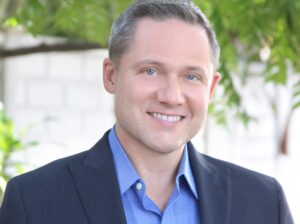
Meet the Therapist

 Jody Morgan, LCSW, CCTP is the founder of the Morgan Center for Counseling and Wellbeing in Boca Raton. He is a compassionate psychotherapist dedicated to helping individuals grow and heal. Jody specializes in trauma-focused treatments and works with clients managing anxiety, depression, and grief.
- Licensed Clinical Social Worker (LCSW)
- Certified Clinical Trauma Professional
- EMDR Certified
- Advanced Certificate in Heart-Centered Clinical Hypnotherapy
- Certificate in Integral Breath Therapy (Integration Concepts)
At Morgan Center, Jody Morgan provides private psychotherapy services that lead to lasting relief. His experience and evidence-based techniques help clients overcome the effects of grief, trauma, and anxiety, and achieve meaningful change. He has helped countless clients who have experienced stress as a result of social media and other exposures, including those working to manage news anxiety, depression, and to break free from the effects of trauma. Treatment services are tailored to meet the specific needs of individuals affected by these issues, offering emotional support and guidance.